

Have you ever said “whatever” during a conversation and instantly regretted how it sounded?
It happens all the time. Maybe you were frustrated, tired, or simply wanted to end the discussion. But the word “whatever” often comes across as dismissive, disrespectful, or uninterested even when that isn’t your intention.
That’s why so many people look for nicer ways to say “whatever.” Whether you’re texting a friend, talking to your partner, chatting with a coworker, or responding to a family member, choosing better words can help you sound calm, respectful, and emotionally mature.
The good news is that you don’t have to completely change your personality. Sometimes, replacing one word with a thoughtful phrase is enough to keep the conversation positive while still expressing how you feel.
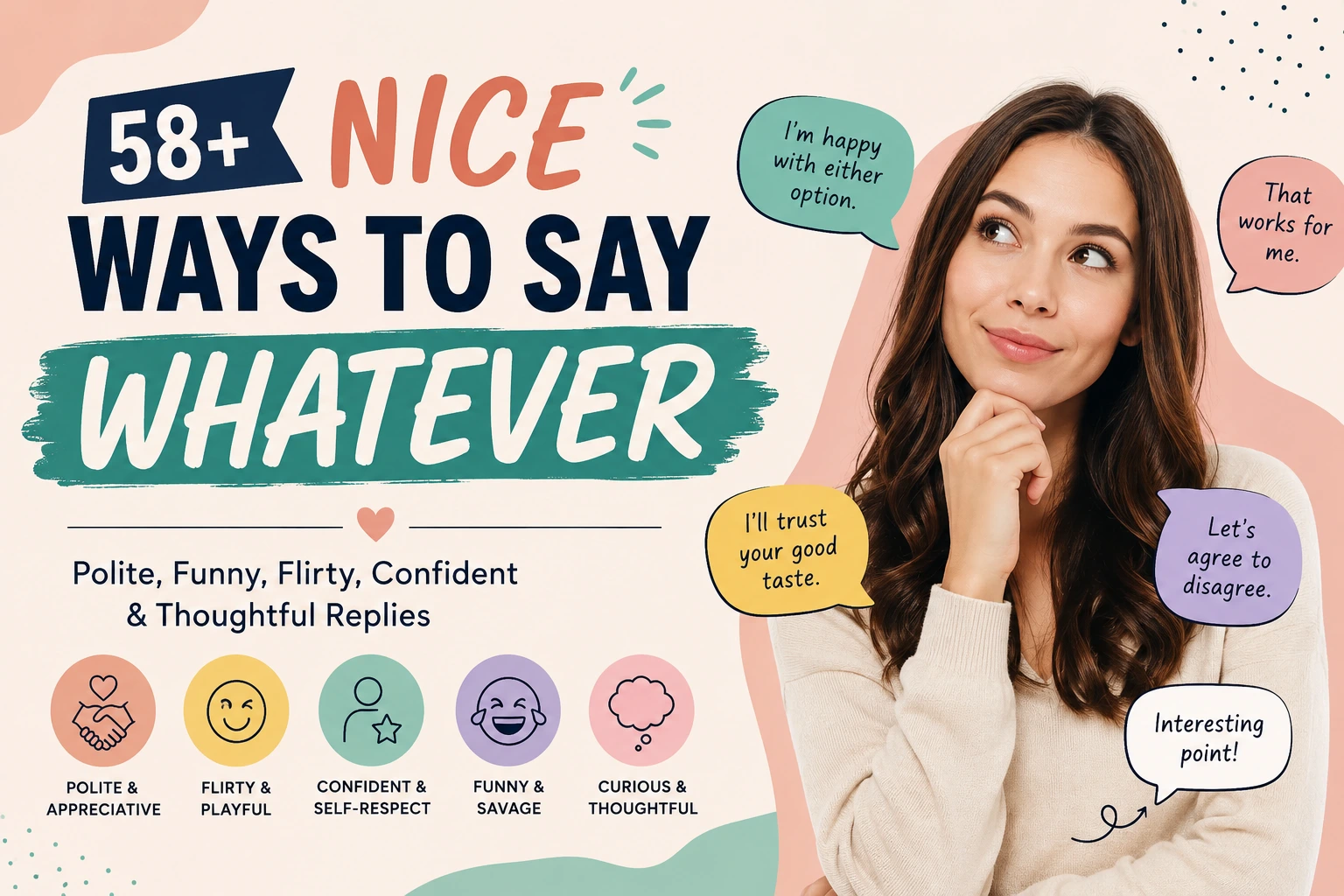
In this guide, you’ll discover over 58 alternatives to “whatever,” organized by different situations and tones. Each reply also includes a realistic example so you know exactly when to use it.
What Does “Whatever” Mean?
The word “whatever” usually means “I don’t mind,” “it doesn’t matter,” or “I’m done arguing.”
The problem is that people often hear it differently than you intended.
Depending on your tone, “whatever” can sound like:
- “I don’t care.”
- “I’m finished talking.”
- “You’re not worth arguing with.”
- “Do what you want.”
For example:
Friend: “We could watch a movie instead.”
You: “Whatever.”
Even if you simply meant, “I’m okay with either choice,” your friend may think you’re annoyed.
That’s why choosing a softer alternative usually creates a better impression.
Polite & Appreciative Replies
1. “I’m okay with either option.”
Reply: “I’m okay with either option.”
Example: Your coworker asks whether to meet at 10 or 11. You smile and say, “I’m okay with either option.”
2. “That works for me.”
Reply: “That works for me.”
Example: Your friend changes the restaurant. Instead of sounding annoyed, you reply, “That works for me.”
3. “I’m happy to go along with your idea.”
Reply: “I’m happy to go along with your idea.”
Example: Your partner chooses the vacation destination. You genuinely say, “I’m happy to go along with your idea.”
4. “I don’t mind.”
Reply: “I don’t mind.”
Example: Someone asks whether you’d rather sit inside or outside. You answer, “I don’t mind.”
5. “Either way is fine.”
Reply: “Either way is fine.”
Example: Two friends can’t decide on dinner. You calmly say, “Either way is fine.”
6. “I’m flexible.”
Reply: “I’m flexible.”
Example: Your team changes the meeting time. You reply, “I’m flexible.”
7. “I’ll leave it up to you.”
Reply: “I’ll leave it up to you.”
Example: Your sibling asks which movie to watch. You answer, “I’ll leave it up to you.”
8. “Sounds good.”
Reply: “Sounds good.”
Example: Someone suggests meeting at a café. You simply reply, “Sounds good.”
9. “Thanks for deciding.”
Reply: “Thanks for deciding.”
Example: Your friend makes the final plan after everyone is undecided. You say, “Thanks for deciding.”
10. “I appreciate your suggestion.”
Reply: “I appreciate your suggestion.”
Example: A coworker recommends a new approach. You respond respectfully, “I appreciate your suggestion.”
Flirty & Playful Replies
11. “I’ll trust your good taste.”
Reply: “I’ll trust your good taste.”
Example: Your crush chooses the date location. You grin and say, “I’ll trust your good taste.”
12. “Surprise me.”
Reply: “Surprise me.”
Example: They ask where you want to eat. You reply, “Surprise me.”
13. “You’re making this easy for me.”
Reply: “You’re making this easy for me.”
Example: They confidently make a plan, and you respond with a smile.
14. “Lead the way.”
Reply: “Lead the way.”
Example: Your date offers to pick the coffee shop. You happily say, “Lead the way.”
15. “I like your ideas.”
Reply: “I like your ideas.”
Example: They recommend a weekend activity. You reply warmly.
16. “I’ll follow your lead this time.”
Reply: “I’ll follow your lead this time.”
Example: Your partner wants to plan the evening. You agree.
17. “You’re the expert.”
Reply: “You’re the expert.”
Example: Your foodie friend chooses the restaurant.
18. “I knew you’d pick something good.”
Reply: “I knew you’d pick something good.”
Example: Your crush suggests a place you’ve always wanted to visit.
19. “Good choice.”
Reply: “Good choice.”
Example: They finally decide on a movie, and you approve.
20. “I’m excited either way.”
Reply: “I’m excited either way.”
Example: Your date gives you two fun options.
Confident & Self-Respect Replies
21. “Let’s agree to disagree.”
Reply: “Let’s agree to disagree.”
Example: You and a friend have different opinions, but neither wants an argument.
22. “I respect your opinion.”
Reply: “I respect your opinion.”
Example: A debate ends peacefully after you say this.
23. “We’ll see it differently.”
Reply: “We’ll see it differently.”
Example: You stay calm during a disagreement.
24. “That’s your perspective.”
Reply: “That’s your perspective.”
Example: Someone criticizes your decision. You respond confidently.
25. “I’ll stick with my decision.”
Reply: “I’ll stick with my decision.”
Example: Friends pressure you to change your mind.
26. “I’m comfortable with my choice.”
Reply: “I’m comfortable with my choice.”
Example: You politely decline unwanted advice.
27. “No hard feelings.”
Reply: “No hard feelings.”
Example: You both decide to move on.
28. “Let’s move forward.”
Reply: “Let’s move forward.”
Example: A disagreement has gone on long enough.
29. “I’m okay leaving it there.”
Reply: “I’m okay leaving it there.”
Example: You want to end the discussion respectfully.
30. “We don’t have to agree.”
Reply: “We don’t have to agree.”
Example: Different opinions don’t have to damage the relationship.
Funny & Savage Replies
31. “If you say so.”
Reply: “If you say so.”
Example: Your friend insists they’re right, and you laugh.
32. “I’ll pretend I didn’t hear that.”
Reply: “I’ll pretend I didn’t hear that.”
Example: Someone jokes a little too confidently.
33. “Interesting theory.”
Reply: “Interesting theory.”
Example: Someone makes a wild claim during a debate.
34. “That’s one way to look at it.”
Reply: “That’s one way to look at it.”
Example: A friend shares an unusual opinion.
35. “Bold opinion.”
Reply: “Bold opinion.”
Example: Someone confidently says something questionable.
36. “Noted.”
Reply: “Noted.”
Example: You don’t want to continue the conversation.
37. “I’ll file that away.”
Reply: “I’ll file that away.”
Example: A friend gives unnecessary advice.
38. “Well… that’s something.”
Reply: “Well… that’s something.”
Example: Someone says something unexpected.
39. “You certainly have confidence.”
Reply: “You certainly have confidence.”
Example: A playful comeback among close friends.
40. “I’ll let you have that one.”
Reply: “I’ll let you have that one.”
Example: Friendly banter after losing an argument.
Curious, Thoughtful & Mature Replies
41. “Can you explain what you mean?”
Reply: “Can you explain what you mean?”
Example: You want to understand instead of assuming.
42. “That’s an interesting point.”
Reply: “That’s an interesting point.”
Example: You’re listening before responding.
43. “Let’s think about it.”
Reply: “Let’s think about it.”
Example: A quick decision doesn’t feel right.
44. “I’d like to hear more.”
Reply: “I’d like to hear more.”
Example: Someone shares a different opinion.
45. “Tell me why you feel that way.”
Reply: “Tell me why you feel that way.”
Example: A friend seems upset.
46. “That’s worth considering.”
Reply: “That’s worth considering.”
Example: Your coworker presents a smart idea.
47. “I understand your point.”
Reply: “I understand your point.”
Example: Even if you disagree, you acknowledge them.
48. “Let’s find a middle ground.”
Reply: “Let’s find a middle ground.”
Example: You both want a fair solution.
49. “Maybe there’s another option.”
Reply: “Maybe there’s another option.”
Example: You’re brainstorming together.
50. “Let’s talk it through.”
Reply: “Let’s talk it through.”
Example: A misunderstanding starts growing.
51. “I’m open to hearing your thoughts.”
Reply: “I’m open to hearing your thoughts.”
Example: You invite a respectful discussion.
52. “Let’s not rush this.”
Reply: “Let’s not rush this.”
Example: A decision needs more thought.
53. “I see where you’re coming from.”
Reply: “I see where you’re coming from.”
Example: You acknowledge their perspective before sharing yours.
54. “We can revisit this later.”
Reply: “We can revisit this later.”
Example: Emotions are running high, so you pause the conversation.
55. “Let’s focus on the solution.”
Reply: “Let’s focus on the solution.”
Example: A team discussion starts turning into blame.
56. “I appreciate your honesty.”
Reply: “I appreciate your honesty.”
Example: Someone gives you difficult but sincere feedback.
57. “I think we’re both making valid points.”
Reply: “I think we’re both making valid points.”
Example: You want to keep the discussion respectful.
58. “Let’s leave it on a good note.”
Reply: “Let’s leave it on a good note.”
Example: You end a conversation positively instead of arguing.
Real-Life Situations
When Your Crush Says, “Whatever.”
Best Reply: “No worries. We can choose something we both enjoy.”
It keeps the conversation positive without making things awkward.
When a Friend Is Joking
Best Reply: “Fair enough. I’ll let you pick this time.”
It keeps the playful vibe going.
When Someone Says It Too Early During an Argument
Best Reply: “I’d rather understand each other than end it like this.”
This encourages a healthier conversation.
When You’re Not Interested
Best Reply: “Thanks, but I’ll pass.”
It’s respectful, clear, and doesn’t create unnecessary drama.
When You’re Tired of Debating
Best Reply: “Let’s agree to disagree.”
You end the discussion with maturity instead of frustration.
What to Avoid
Avoid these common mistakes when replacing “whatever”:
- Using a sarcastic tone that changes the meaning.
- Pretending to agree when you actually don’t.
- Choosing passive-aggressive phrases just to end the conversation.
- Sounding cold or dismissive in text messages.
- Overexplaining simple situations.
- Ignoring the other person’s feelings.
Pro Tips
- Match your words with a calm tone. Even the nicest phrase can sound rude if delivered sarcastically.
- Choose replies based on the relationship. A playful response may work with friends but not at work.
- Don’t rush to respond. Taking a moment before speaking often leads to a more thoughtful answer.
Bonus: Quick One-Liner Replies
- That works for me.
- Sounds good.
- I’m fine either way.
- I’ll trust your judgment.
- No problem.
- Let’s do that.
- I’m good with it.
- Fair enough.
- Thanks for letting me know.
- Let’s move on.
Conclusion
Replacing “whatever” with a kinder, more thoughtful response doesn’t mean you’re giving up your opinion. It simply shows confidence, emotional intelligence, and respect for the person you’re talking to.
Whether you’re texting a friend, talking to your partner, or handling a difficult conversation, the right words can completely change the mood. The next time you’re tempted to say “whatever,” choose one of these alternatives instead you’ll sound more mature, approachable, and confident without losing your authenticity.
Discover more