

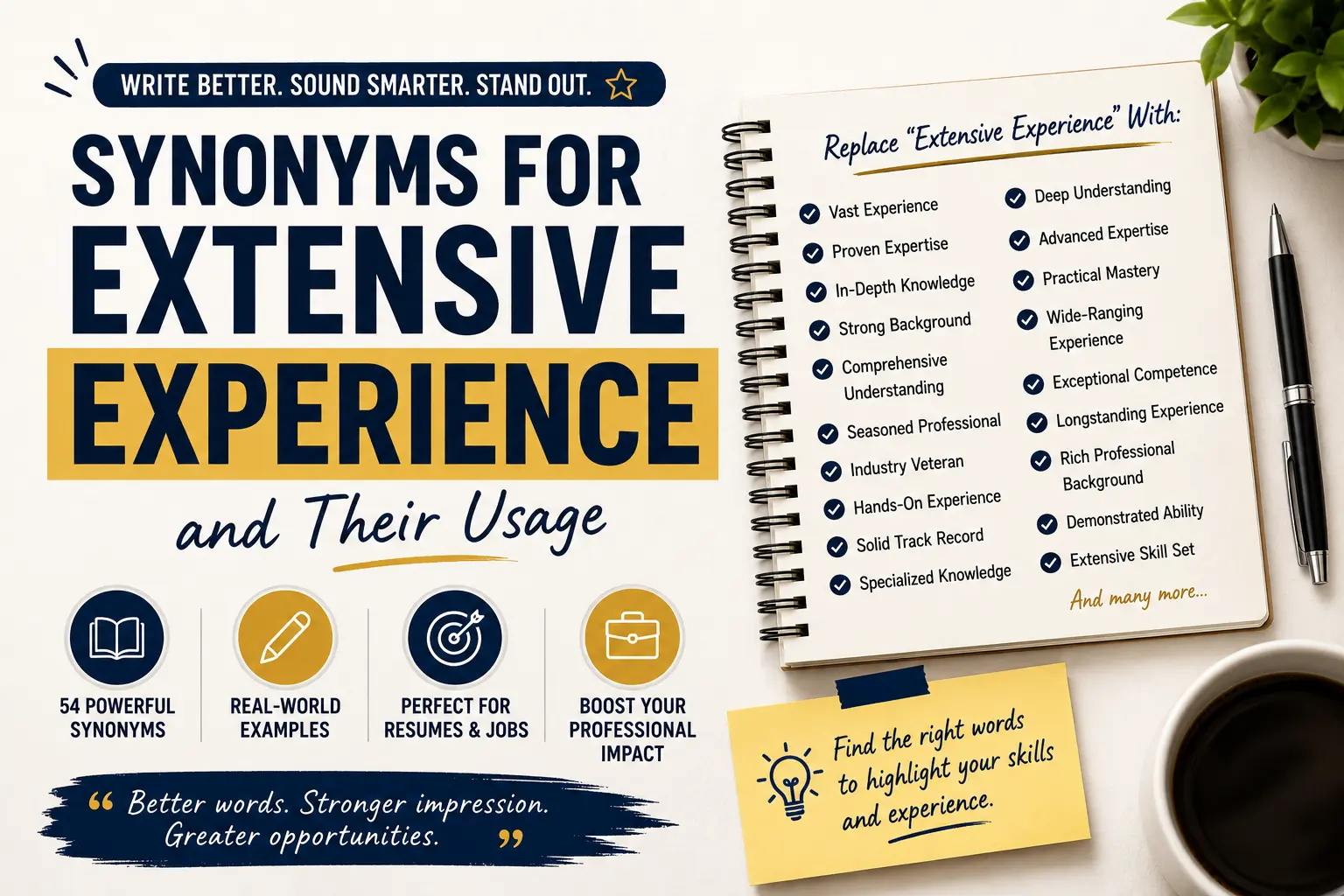
Whether you are updating your resume, writing a LinkedIn profile, preparing a job application, or simply trying to sound more professional, there comes a moment when the phrase “extensive experience” starts to feel overused. You know you have years of knowledge and skills, but you want words that sound fresh, confident, and impressive.
That is exactly why people search for synonyms for extensive experience and their usage. The right phrase can make your qualifications stand out, showcase your expertise, and help you communicate your value more effectively.
Instead of repeating the same expression over and over, you can choose alternatives that fit different situations, industries, and tones. In this guide, you will discover 54 powerful synonyms, real life examples, practical tips, and the best ways to use them in everyday and professional writing.
What Does “Synonyms for Extensive Experience and Their Usage” Mean?
Synonyms for extensive experience are alternative words and phrases that describe someone who has a great deal of knowledge, skill, or practical involvement in a particular field.
People use these expressions in resumes, cover letters, job interviews, business presentations, and professional conversations to highlight their expertise without sounding repetitive.
For example, instead of saying, “I have extensive experience in marketing,” you could say, “I have a proven track record in marketing” or “I possess deep industry expertise.”
Choosing the right synonym depends on the context, your audience, and the message you want to communicate.
Professional and Polite Alternatives
1. Reply: “Vast experience”
Example: A project manager writes, “I have vast experience leading international teams.”
2. Reply: “Broad expertise”
Example: A consultant highlights broad expertise in business strategy.
3. Reply: “Strong background”
Example: A teacher mentions a strong background in educational research.
4. Reply: “In depth knowledge”
Example: An engineer emphasizes in depth knowledge of software systems.
5. Reply: “Comprehensive understanding”
Example: A lawyer describes a comprehensive understanding of corporate law.
6. Reply: “Extensive knowledge base”
Example: A medical professional includes this phrase in a resume.
7. Reply: “Proven expertise”
Example: A candidate showcases proven expertise in digital marketing.
8. Reply: “Longstanding experience”
Example: A manager mentions longstanding experience in leadership.
9. Reply: “Professional proficiency”
Example: A designer uses this term in a portfolio.
10. Reply: “Established skills”
Example: A developer highlights established skills in programming.
11. Reply: “Advanced capabilities”
Example: A data analyst describes advanced capabilities in analytics.
Confident and Self Assured Alternatives
12. Reply: “Seasoned professional”
Example: A recruiter calls a senior executive a seasoned professional.
13. Reply: “Industry veteran”
Example: A speaker introduces herself as an industry veteran.
14. Reply: “Highly experienced”
Example: A company profile describes its team as highly experienced.
15. Reply: “Expert level knowledge”
Example: A software engineer lists expert level knowledge of coding languages.
16. Reply: “Mastery of the field”
Example: An artist demonstrates mastery of the field through awards.
17. Reply: “Exceptional competence”
Example: A manager praises an employee’s exceptional competence.
18. Reply: “Significant expertise”
Example: A consultant mentions significant expertise in finance.
19. Reply: “Specialized knowledge”
Example: A doctor highlights specialized knowledge in cardiology.
20. Reply: “Deep understanding”
Example: A professor explains her deep understanding of psychology.
21. Reply: “Practical mastery”
Example: A chef showcases practical mastery of culinary techniques.
22. Reply: “Expert proficiency”
Example: A graphic designer uses this phrase in a job application.
Thoughtful and Mature Alternatives
23. Reply: “Years of hands on experience”
Example: A mechanic emphasizes years of hands on experience.
24. Reply: “Rich professional background”
Example: An executive summarizes a rich professional background.
25. Reply: “Solid track record”
Example: A salesperson highlights a solid track record of success.
26. Reply: “Demonstrated ability”
Example: A resume showcases demonstrated ability in project management.
27. Reply: “Practical expertise”
Example: A trainer mentions practical expertise in communication.
28. Reply: “Extensive skill set”
Example: A designer lists an extensive skill set.
29. Reply: “Professional insight”
Example: A mentor shares professional insight with students.
30. Reply: “Wide ranging experience”
Example: A journalist describes wide ranging experience in media.
31. Reply: “Refined abilities”
Example: A musician talks about refined abilities developed over time.
32. Reply: “Well developed expertise”
Example: An architect highlights well developed expertise.
33. Reply: “Practical knowledge”
Example: A technician emphasizes practical knowledge.
Playful and Creative Alternatives
34. Reply: “Been around the block”
Example: A friend jokingly says this about an experienced manager.
35. Reply: “Knows the ropes”
Example: A new employee says the team leader knows the ropes.
36. Reply: “Old hand at it”
Example: A colleague describes a veteran writer as an old hand at it.
37. Reply: “Seen it all”
Example: A nurse laughs and says she has seen it all.
38. Reply: “Battle tested”
Example: A startup founder describes himself as battle tested.
39. Reply: “Road tested”
Example: A salesperson says her strategies are road tested.
40. Reply: “Experienced pair of hands”
Example: A company introduces a new executive this way.
41. Reply: “Skill packed background”
Example: A creative agency uses this phrase playfully.
42. Reply: “Knowledge powerhouse”
Example: A team member calls his mentor a knowledge powerhouse.
43. Reply: “Expert by practice”
Example: A photographer describes years of learning through practice.
Funny and Bold Alternatives
44. Reply: “Professional survivor”
Example: A worker jokes after twenty years in the industry.
45. Reply: “Office dinosaur”
Example: A senior employee jokingly calls himself an office dinosaur.
46. Reply: “Veteran of countless meetings”
Example: A manager laughs before a presentation.
47. Reply: “Coffee powered expert”
Example: A programmer jokes in her online bio.
48. Reply: “Certified problem solver”
Example: A consultant uses this phrase humorously.
49. Reply: “Deadline warrior”
Example: A journalist describes years of experience.
50. Reply: “Spreadsheet champion”
Example: An accountant jokes with colleagues.
51. Reply: “Seasoned multitasker”
Example: A project manager uses this phrase in conversation.
52. Reply: “Meeting room legend”
Example: Coworkers jokingly describe their boss this way.
53. Reply: “Professional fire fighter”
Example: A manager jokes about constantly solving problems.
54. Reply: “Corporate ninja”
Example: A marketing executive playfully describes herself online.
Real Life Situations
When writing a resume
Best alternative: “Proven expertise”
Example: “I have proven expertise in customer relationship management.”
When updating your LinkedIn profile
Best alternative: “Seasoned professional”
Example: “Seasoned professional with ten years of experience in finance.”
During a job interview
Best alternative: “Deep understanding”
Example: “I have a deep understanding of project coordination.”
When writing a cover letter
Best alternative: “Strong background”
Example: “I bring a strong background in software development.”
When introducing yourself at a conference
Best alternative: “Industry veteran”
Example: “I am an industry veteran with experience in international markets.”
What to Avoid
Avoid repeating the same phrase
Using “extensive experience” too many times makes your writing dull.
Avoid exaggeration
Choose words that honestly reflect your skills.
Avoid overly casual terms in formal settings
Phrases like “office dinosaur” do not belong in a resume.
Avoid vague language
Use specific examples whenever possible.
Avoid buzzwords without proof
Support your claims with achievements and results.
Avoid using difficult words unnecessarily
Keep your language clear and natural.
Pro Tips
Match the phrase to the situation
Formal applications require professional language, while social media allows more creativity.
Back up your words with evidence
A strong synonym becomes even stronger when paired with real achievements.
Focus on clarity
Simple, confident language often makes a bigger impact than complicated vocabulary.
Bonus: Quick One Liners
“Seasoned professional”
“Proven expertise”
“Deep industry knowledge”
“Broad expertise”
“Strong background”
“Practical mastery”
“Extensive skill set”
“Longstanding experience”
“Solid track record”
“Specialized knowledge”
Conclusion
Finding the right synonym for extensive experience can instantly improve your resume, cover letter, or professional profile. The best alternatives are the ones that sound natural, fit the situation, and accurately represent your skills.
Remember, impressive language matters, but real expertise speaks louder than any phrase. Choose words that reflect your journey and let your experience shine.
Discover more
different ways to say i just arrived