
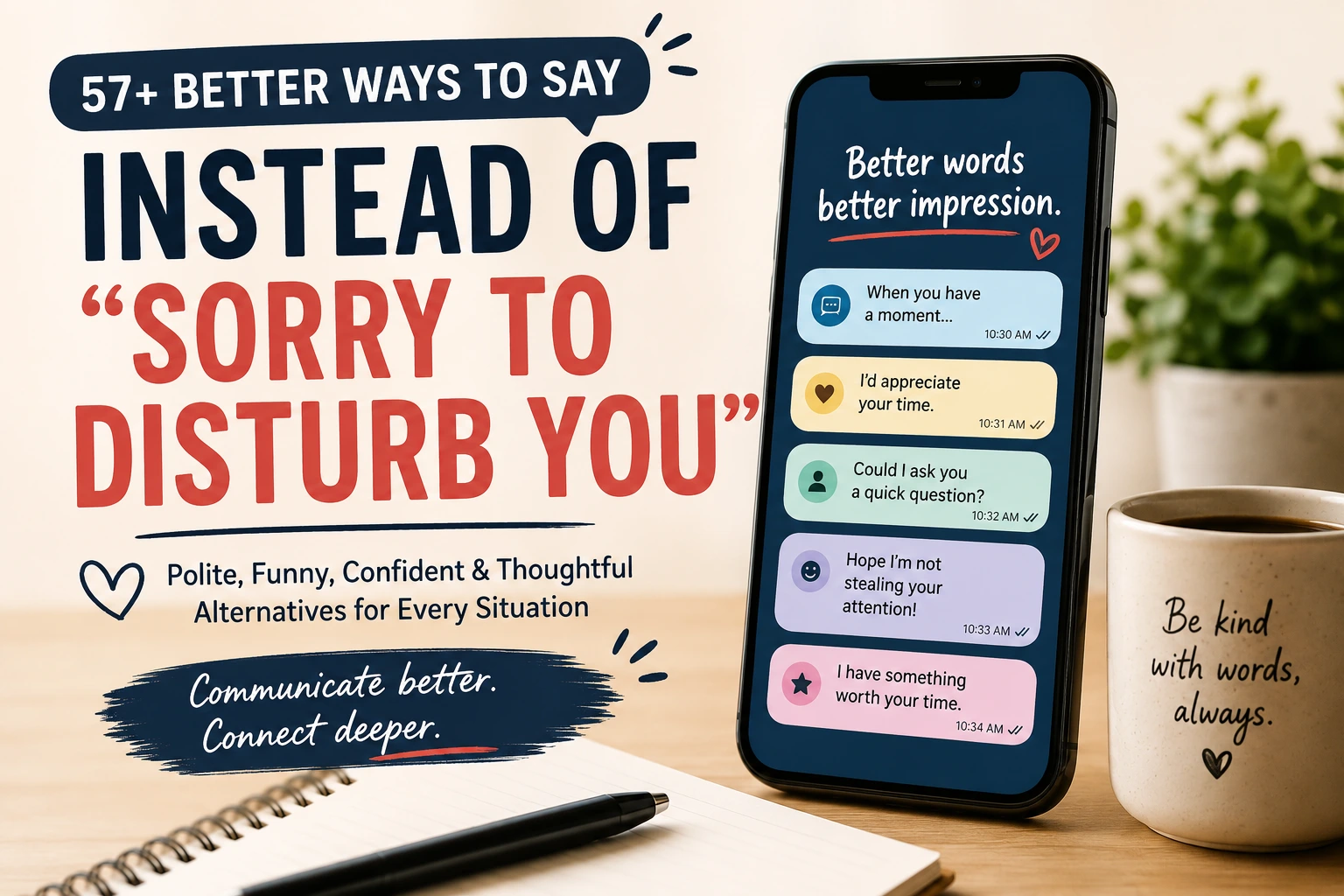
Have you ever stared at your phone, typed “Sorry to disturb you,” and then wondered if there was a better way to say it? You’re not alone. Whether you’re sending a work email, texting a friend, messaging your crush, or asking someone for help, those four words can sometimes sound overly apologetic or even make you seem less confident than you really are.
The good news is that you don’t always need to apologize just for starting a conversation. There are plenty of polite, warm, and confident alternatives that sound more natural while still showing respect for the other person’s time. In this guide, you’ll discover the best other words to say instead of sorry to disturb you, when to use them, and real life examples that make every reply easy to understand.
What Does “Sorry to Disturb You” Mean?
“Sorry to disturb you” is a polite phrase people use before asking a question, requesting help, or interrupting someone who may be busy. It shows consideration and respect for the other person’s time.
People often use it in situations like:
- Sending a work email.
- Asking a teacher a question.
- Messaging someone you haven’t spoken to in a while.
- Interrupting a meeting.
- Texting a friend who seems busy.
While it’s polite, saying it too often can make you sound overly apologetic. Sometimes a friendly greeting or a confident opening works even better.
57 Best Alternatives to Say Instead of Sorry to Disturb You
Polite and Appreciative
1. When you have a moment
Reply: “When you have a moment, could you help me with something?”
Example: You text your manager after work hours but let them answer whenever they’re available.
2. I appreciate your time
Reply: “I appreciate your time. I have a quick question.”
Example: You email a professor before an assignment deadline.
3. If you’re available
Reply: “If you’re available, I’d love your advice.”
Example: You ask a colleague for feedback on a project.
4. I’d like to ask something
Reply: “I’d like to ask something whenever you’re free.”
Example: You message your mentor about career advice.
5. May I ask you a quick question?
Reply: “May I ask you a quick question?”
Example: You approach a coworker who’s organizing documents.
6. Whenever it’s convenient
Reply: “Whenever it’s convenient, could you let me know?”
Example: You ask a client for an update without creating pressure.
7. I hope this is a good time
Reply: “I hope this is a good time to ask.”
Example: You call a relative during the evening.
8. I’d appreciate your help
Reply: “I’d appreciate your help when you get a chance.”
Example: You message a classmate for lecture notes.
9. Could I borrow a minute?
Reply: “Could I borrow a minute of your time?”
Example: You stop your supervisor for a brief discussion.
10. Thanks for taking a look
Reply: “Thanks for taking a look whenever you can.”
Example: You send someone a document for review.
Flirty and Playful
11. Hope I’m not stealing your attention
Reply: “Hope I’m not stealing your attention.”
Example: You text your crush in the evening.
12. I promise I’ll be quick
Reply: “I promise I’ll be quick.”
Example: You send your partner a message during work hours.
13. Mind if I interrupt your day?
Reply: “Mind if I interrupt your day for a minute?”
Example: You message someone you’ve been flirting with.
14. I couldn’t resist texting you
Reply: “I couldn’t resist texting you.”
Example: You haven’t spoken for a few days and want to reconnect.
15. I have something worth your time
Reply: “I have something worth your time.”
Example: You tease your crush before sharing exciting news.
16. Guess who couldn’t stay quiet
Reply: “Guess who couldn’t stay quiet?”
Example: You send a playful message after seeing something funny.
17. I needed your opinion
Reply: “I needed your opinion.”
Example: You ask your partner to help choose an outfit.
18. I hope you’ll forgive this message
Reply: “I hope you’ll forgive this unexpected message.”
Example: You text someone late in the evening.
19. Can I borrow your smile for a minute?
Reply: “Can I borrow your smile for a minute?”
Example: You send a cheerful morning text.
20. You’re the first person I thought of
Reply: “You’re the first person I thought of.”
Example: You share exciting news with someone special.
Confident and Self Respect
21. I have a quick question
Reply: “I have a quick question.”
Example: You message your boss without unnecessary apologies.
22. I’d like your input
Reply: “I’d like your input on something.”
Example: You ask a teammate for feedback.
23. Could we chat when you’re free?
Reply: “Could we chat when you’re free?”
Example: You want to discuss an upcoming project.
24. I’d love your thoughts
Reply: “I’d love your thoughts on this.”
Example: You ask a friend about a big decision.
25. Let me know when you have time
Reply: “Let me know when you have time.”
Example: You send a message without expecting an instant reply.
26. I’d appreciate your perspective
Reply: “I’d appreciate your perspective.”
Example: You ask an experienced coworker for advice.
27. Can we connect later?
Reply: “Can we connect later?”
Example: You know the other person is currently busy.
28. I wanted to check in
Reply: “I wanted to check in.”
Example: You reconnect with an old friend.
29. Here’s a quick update
Reply: “Here’s a quick update.”
Example: You inform your team about completed work.
30. Whenever you’re ready
Reply: “Whenever you’re ready, let me know.”
Example: You give someone space before continuing the conversation.
Funny and Savage
31. I come bearing questions
Reply: “I come bearing questions.”
Example: You text your sibling before asking for help.
32. Your favorite notification just arrived
Reply: “Your favorite notification just arrived.”
Example: You jokingly message your best friend.
33. I promise this isn’t another emergency
Reply: “I promise this isn’t another emergency.”
Example: You’ve asked for help several times recently.
34. I interrupted your scrolling
Reply: “I interrupted your scrolling, didn’t I?”
Example: You text a friend who’s always online.
35. I need your wisdom
Reply: “I need your wisdom.”
Example: You jokingly ask your smart friend for advice.
36. Congratulations, you’ve been selected
Reply: “Congratulations, you’ve been selected.”
Example: You playfully volunteer your roommate to help.
37. Time for your daily favor
Reply: “Time for your daily favor.”
Example: You tease your close friend.
38. I promise this is interesting
Reply: “I promise this is actually interesting.”
Example: You interrupt a group chat.
39. Please pretend I’m important
Reply: “Please pretend I’m important for one minute.”
Example: You jokingly ask your cousin to answer quickly.
40. Don’t panic, it’s only me
Reply: “Don’t panic, it’s only me.”
Example: You unexpectedly text someone after a long break.
Curious Thoughtful and Mature
41. I’d value your opinion
Reply: “I’d value your opinion.”
Example: You ask a trusted friend before making a decision.
42. Can I get your advice?
Reply: “Can I get your advice?”
Example: You ask a mentor about career choices.
43. I’d like your thoughts when you have time
Reply: “I’d like your thoughts when you have time.”
Example: You send an email about an important proposal.
44. Whenever you’re comfortable
Reply: “Whenever you’re comfortable, let me know.”
Example: You discuss a sensitive topic with a friend.
45. I’d appreciate your perspective
Reply: “I’d appreciate your perspective.”
Example: You ask someone you trust before making a big purchase.
46. Could I hear your thoughts?
Reply: “Could I hear your thoughts?”
Example: You ask your partner after sharing an idea.
47. I’d love to hear what you think
Reply: “I’d love to hear what you think.”
Example: You send your writing to a friend.
48. If now isn’t ideal, no worries
Reply: “If now isn’t ideal, no worries.”
Example: You text someone during their workday.
49. I’d be grateful for your help
Reply: “I’d be grateful for your help.”
Example: You ask a family member for advice.
50. Let me know what works for you
Reply: “Let me know what works for you.”
Example: You schedule a meeting with a client.
51. Whenever you get the chance
Reply: “Whenever you get the chance, I’d appreciate a reply.”
Example: You send a follow up message.
52. No rush at all
Reply: “No rush at all.”
Example: You ask someone to review your presentation.
53. I’d be happy to wait
Reply: “I’d be happy to wait until you’re free.”
Example: You know your friend has exams.
54. I’d love a minute of your time
Reply: “I’d love a minute of your time.”
Example: You ask your professor after class.
55. Could you help when you’re free?
Reply: “Could you help when you’re free?”
Example: You message a coworker during lunch.
56. I’d appreciate a quick favor
Reply: “I’d appreciate a quick favor.”
Example: You ask your neighbor to collect a package.
57. I’d love to connect
Reply: “I’d love to connect whenever you’re available.”
Example: You reach out to an old colleague.
Real Life Situations
When Your Crush Says It
Best reply:
“I was hoping you’d text me.”
This feels warm, playful, and welcoming without trying too hard.
When a Friend Jokes About Disturbing You
Best reply:
“You could never bother me.”
It reassures them while keeping the conversation light.
When Someone Says It Too Early
Best reply:
“You’re not disturbing me at all.”
This instantly makes the other person feel comfortable.
When You’re Not Interested
Best reply:
“I’m a little busy right now, but I’ll get back to you later.”
It’s polite, honest, and respectful.
When It’s a Work Conversation
Best reply:
“When you have time, I’d be happy to discuss it.”
Professional, confident, and considerate.
What to Avoid
- Apologizing multiple times in the same message.
- Writing long introductions before asking your question.
- Sounding overly guilty for simply starting a conversation.
- Expecting an immediate reply after saying they’re probably busy.
- Using very formal language with close friends.
- Choosing playful wording in serious professional situations.
Pro Tips
- Match your tone to the relationship. Professional conversations need different wording than casual chats.
- Confidence is often more effective than unnecessary apologies. Respect someone’s time without putting yourself down.
- Keep your opening short. People appreciate messages that get to the point while remaining polite.
Bonus Quick One Liners
- When you’re free, I’d love your help.
- Can I ask you something?
- I have a quick favor.
- I’d appreciate your thoughts.
- Let me know when you have a minute.
- Hope you’re doing well.
- I’d love your advice.
- Whenever you have time.
- Could we chat later?
- Looking forward to hearing from you.
Conclusion
You don’t always have to begin a conversation with “Sorry to disturb you.” In many situations, a confident, friendly, and respectful opening creates a much better first impression. Whether you’re texting a friend, emailing a coworker, or reaching out to someone special, choosing the right words helps you sound more natural and self assured.
Discover more